Andrea Tashquinth
Day of the DeadAndrea Tashquinth is the older daughter of Henry Orozco and Emma Orozco, and the sister whose childhood memories reopen questions about Roseanne Orozco’s disappearance and murder. She is introduced as a produce manager at Basha’s in Sells, but her importance to the investigation lies in what she witnessed, what she tried to report, and how little weight officials gave her account. For years, suspicion fell on her father; Andrea’s recollections instead direct attention toward the school that traumatized Roseanne and the hospital from which she vanished.
Identity and Family Background
Emma identifies Andrea as her older daughter and recalls that the family called her Mithol-mad, meaning Kitten. Roseanne, the younger child, was called Tachchuithch, which Brandon Walker recognizes as meaning Beloved. Andrea is nearly two years older than Roseanne. Their parents worked as migrant laborers, leaving for California, Washington, or Oregon for months at a time while the girls stayed with their paternal grandmother in Ak Chin.
As an adult, Andrea lives in Big Fields in a long, low adobe house that appears to have been added to over time. When Brandon visits, she is guarded and asks what he wants. Her resemblance to Emma is immediately apparent to him. She works as the produce manager at Basha’s, a role that marks a changed landscape on the reservation: Brandon recalls that, during his earlier visits, its trading posts offered staples but not a proper produce department. Andrea emerges from a back room pushing a cart of bananas when he first approaches her at work.
Childhood and Roseanne’s Silence
Andrea’s account begins with the girls’ separation on Roseanne’s first day of school. The grandmother was, in Andrea’s recollection, mean, and Roseanne cried because she feared being left alone with her. When Andrea returned from school, Roseanne pleaded to go with her the next day. Andrea falsely told their grandmother that Roseanne was expected at school too, and the grandmother allowed them both to leave.
At school, Roseanne became frightened when she learned she could not be in Andrea’s class. She cried until the principal arrived. Andrea describes him as a huge man who lifted Roseanne under his arm and carried her down the hall while she kicked and screamed. Andrea followed, repeatedly urging him to put Roseanne down, but he continued to his office, put the child in a dark coat closet, and shut the door. He sent Andrea back to class; she could still hear Roseanne crying as she went.
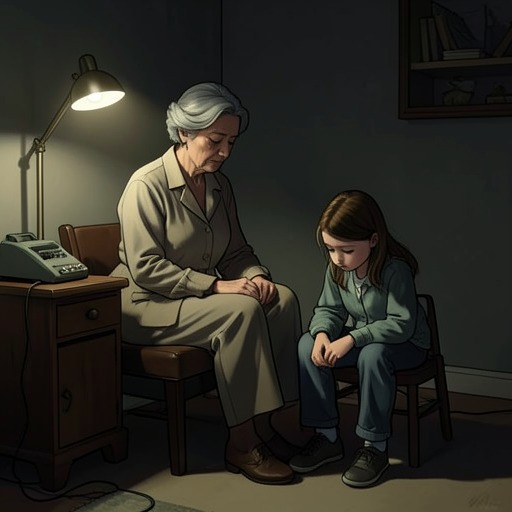
Andrea did not see her sister again until it was time to board the bus after school. Roseanne’s face was wet, and on the journey home she would not answer Andrea’s questions. She never spoke again—not to Andrea, not to their parents, and especially not at school. Their father nevertheless made her attend. She did not answer questions or turn in papers. The family took her to doctors in the area and in Phoenix, but they found no explanation; Henry also consulted a medicine man, who said there was nothing he could do. Andrea’s story links Roseanne’s lifelong mutism to a particular episode of fear and forced separation, rather than presenting it as an unexplained condition.
The Disappearance and Andrea’s Warning
Years later, Brandon meets Andrea in his Suburban. She initially objects to Emma bringing up the old case again: Roseanne is dead, she says, and the suspicion directed at Henry never led to an arrest or proof, yet it damaged his life. People talked about him behind his back, and the family knew it. Brandon tells her that reopening the past will bring pain to everyone connected to Roseanne. Andrea begins to sob and says she thinks about it every day, blaming herself.
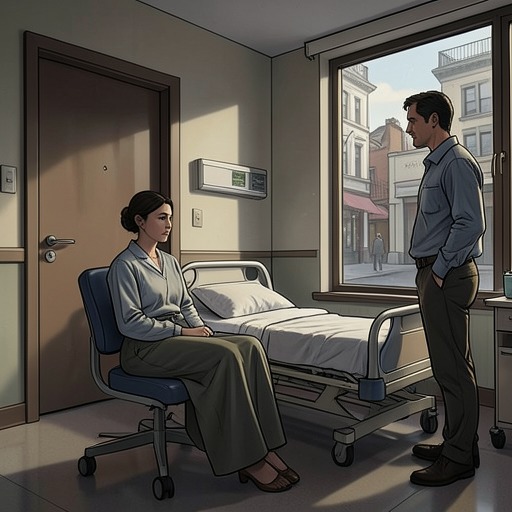
Her guilt is tied to the childhood lie that first took Roseanne to school, but her later recollection concerns a separate disappearance. Roseanne had an appendectomy in the summer and was expected to recover. When she remained ill and could not start school, Emma took her to a doctor, who admitted her for tests. Henry was supposed to collect her after work when she was discharged. He arrived to find that she was gone. The family initially assumed she had walked out of the hospital; the following week, her body was found in an ice chest beside the road.
Sitting in Brandon’s vehicle outside the hospital, Andrea finally says that the disappearance had to have happened there. She had tried to tell Law and Order at the time, but nobody listened. She was sixteen, and, as she explains, nobody was interested in her opinions. When Brandon asks whom she suspects, Andrea does not claim to know: she proposes that it might have been someone working at the hospital, perhaps an orderly or nurse, or someone visiting a patient. Her account establishes a line of inquiry, not an identification of the killer.
Testimony, Investigation, and Significance
Andrea’s testimony enters the case in stages. Fat Crack Ortiz tells Brandon that Henry was a good man and suggests speaking with Andrea, who now works at Basha’s. Brandon already intends to find her because Emma said she would be there. Andrea’s first response is distrust, and the memory of the investigation is inseparable from the harm done to her father by suspicion that was never proved. Only after Brandon acknowledges the pain of remembering does she recount the childhood events and the hospital clue.
Her experience also exposes how a witness can be present without being heard. Andrea says that she tried to report her hospital suspicion when she was sixteen, but investigators discounted her. Later, the record search deepens the problem: Emma is told that there is no record of Roseanne’s admission and that records from so long ago may have been lost. Emma rejects that explanation because the hospital has retained her own records of three admissions, including the births of both daughters and a hysterectomy. The contrast does not establish what happened to Roseanne’s file, but it gives Emma reason to believe the absence is not simply a matter of age.
Andrea is therefore both a witness to Roseanne’s earliest trauma and a source of an overlooked lead in the murder investigation. Her memories distinguish two moments that the family and investigators had failed to connect: the school episode followed by Roseanne’s silence, and the later hospital stay followed by her disappearance. The case had long been organized around suspicion of Henry, while Andrea’s account points toward questions about the institutions that handled Roseanne and the possibility that someone at the hospital had access to her. The evidence does not resolve those questions, but her testimony restores a neglected perspective to the investigation and makes the cost of not listening part of the case itself.